E1: Renewable Energy Communities
Energy Use cases

This use case focuses on improving the way energy is managed in smart buildings and renewable energy communities by using B5G/6G connectivity, IoT devices and AI models running at the edge or cloud. The system collects data from sensors measuring temperature, presence and energy consumption and combines it with user preferences to jointly optimize comfort and energy use. The aim is to control heating, cooling, ventilation, and lighting automatically across single buildings and, later, across groups of collaborative buildings. The communication layer relies on low-latency B5G/6G connectivity to ensure that data from sensors and actuators is received and processed quickly, while the application layer uses prediction models to estimate energy demand and adjust control strategies in real time.
During the first year of the project execution, the main software components of the Smart Building Energy Management System were designed and implemented, including the IoT data platform, the orchestration tools, the monitoring system, and the MLOps framework. These modules have been tested in the Nextworks laboratory and initial integration activities have started in the 5G ORO lab.
The IoT platform has been validated with environmental and power-consumption sensors, while the AI models for energy consumption prediction have been trained using public datasets and prepared for deployment through the MLOps platform. The current implementation supports a full single-building setup, which will be extended to Renewable Energy Community scenarios in the next phase. Next steps include deploying the system in the 5G ORO lab for preliminary testing in 2026 and preparing the extensions needed for multi-building REC optimization. In parallel, an Intent-Based GenAI framework for network slicing optimization and resource automation will be introduced by CAPG (Capgemini Engineering), enabling high-level intent translation, slice configuration, and QoS adaptation within the B5G infrastructure.
E2: Robotized offshore wind turbine blade inspection and maintenance
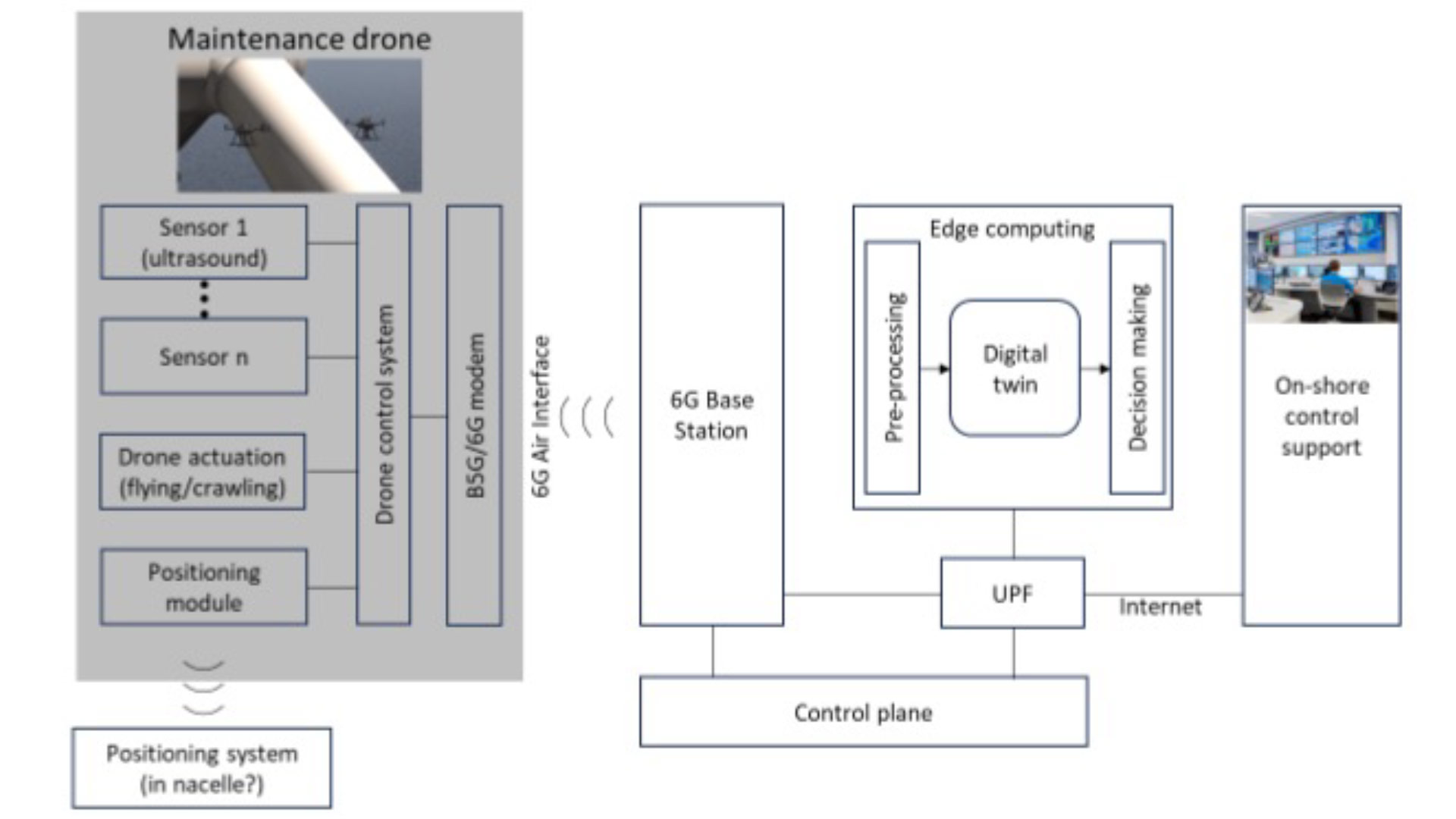
This use case aims to demonstrate how B5G connectivity and edge computing can support automated inspection of offshore wind turbine blades using drones equipped with cameras, ultrasound and positioning sensors. The objective is to reduce the need for physical access to the turbine, lower operational risks and provide faster insight into blade condition. Data captured during drone flights is sent over the B5G network to an onshore digital-twin system, where it is processed in real time to detect structural issues. The scope includes a full B5G testbed, UAV integration, an edge-processing layer and network slicing features to ensure stable uplink transmission and low latency. In the first project year, the Zephyros Lab in Vlissingen has been prepared as the main integration site and equipped with a real turbine blade for testing. The Amarisoft small cell and spectrum license were secured, enabling deployment of the local B5G network. Initial tests have verified basic connectivity using the Quectel 5G module and early sensor evaluations have begun on the AIRTuB-ROMI drone. High-precision GNSS-RTK equipment has been prepared for hybrid localization, and the design of the network slicing configuration was completed. Preliminary trial plans were validated and KPIs covering uplink throughput, latency, service availability and localization accuracy were confirmed.
E3: Solar energy monitoring, control and predictions using B5G/6G communications and edge-cloud

In this use case, we focus on creating a unified platform for real-time monitoring, control and forecasting of solar energy production using B5G/6G communication and edge–cloud technologies. The system connects photovoltaic inverters through an IoT gateway that reads field data over Modbus and forwards it securely to the cloud using MQTT. The cloud layer provides device management, visualization, forecasting models and control features. This architecture supports the full chain of data collection, processing and optimization, enabling more accurate production forecasts, remote control of inverters and fast reaction to grid-related events. KPIs for latency, reliability and end-to-end data delivery have been defined to evaluate how well the system performs over 5G/6G networks. During the first year, the IoT edge gateway was developed and tested in the SIMTEL laboratory, successfully reading inverter data and executing remote control commands. A basic cloud backend was deployed to validate communication flows and supports continuous data ingestion. Integration work with RedCap-based 5G modules is ongoing, preparing the system for operation over the ORO 5G Lab testbed. A hardware version of the custom gateway is under development, and cloud features for storage, dashboards and analytics are being extended. ML components for solar forecasting are being prepared by CAPG, using data collected from the SIMTEL solar park. The technical enablers for intent-based operation, AI-as-a-Service and MLOps integration have been aligned with use case needs.
Use case
- Renewable Energy Communities
- Robotized offshore wind turbine blade inspection and maintenance
- Solar energy monitoring, control and predictions using B5G/6G communications and edge-cloud
Sustainability aspects (i) Environmental, (ii) Societal, (iii) Economic
(i) increased production and usage of renewable energy, reduced energy consumption;
(ii) increased health, safety, and quality of life;
(iii) increased revenue from renewable energy production, reduced energy costs
Related sites
Romanian
Dutch
Romanian