
H1: Wearable ultrasound patch for cardiac function monitoring
Health Use cases
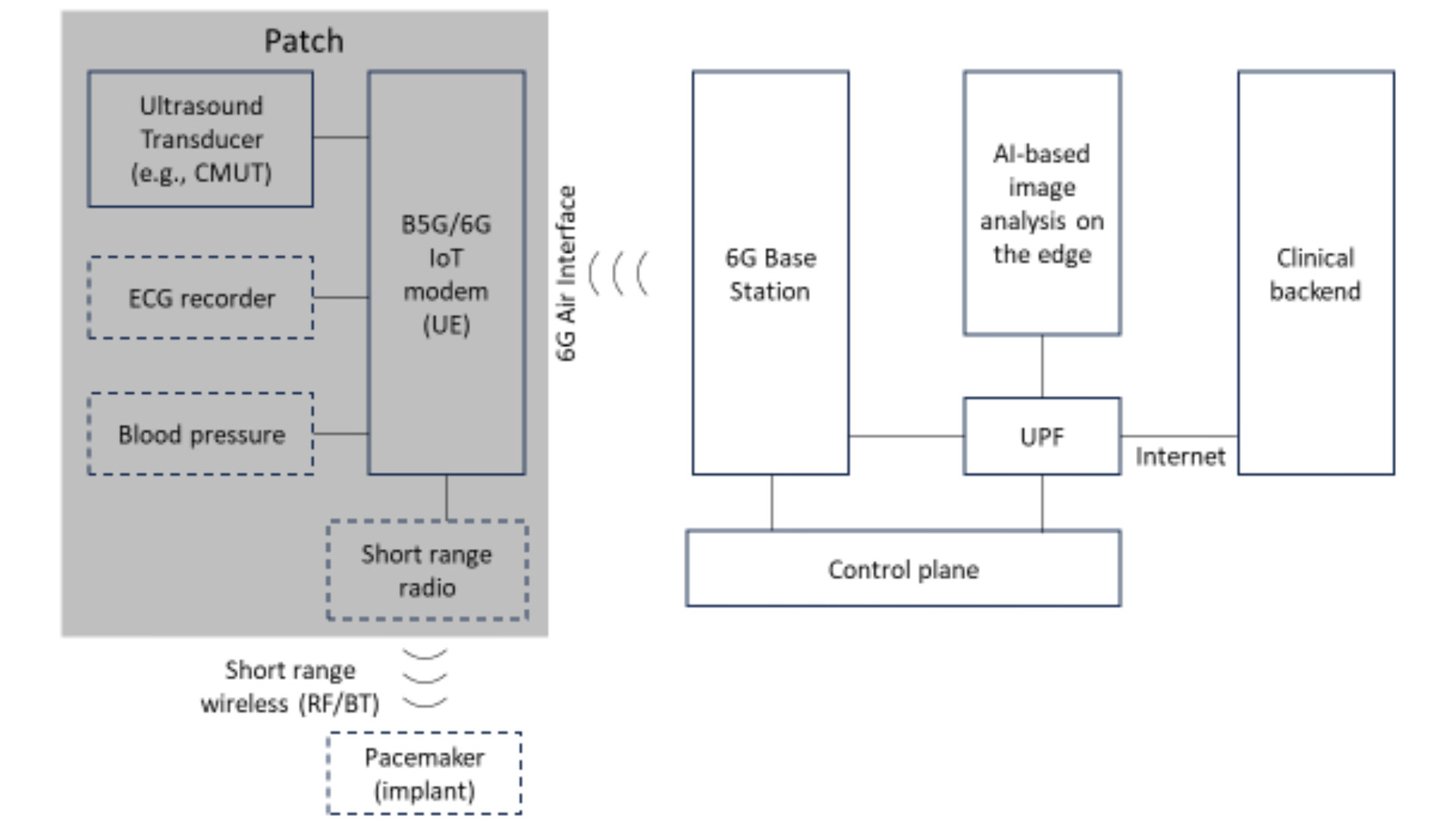
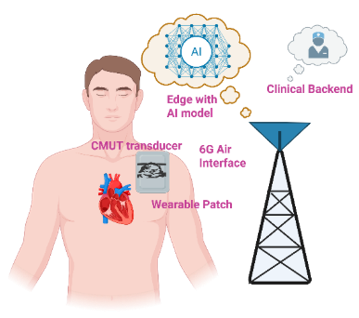
The use case focuses on novel ways to perform cardiac ultrasound assessment, an indispensable tool for the diagnosis, intervention and follow-up of heart patients. New adhesive-patch-based, ultrasound devices, leveraging Capacitive Micromachined Ultrasonic Transducer (CMUT) and similar transducer technologies, are appearing on the market. These patches can be semi-permanently attached to the patient’s body enabling more frequent assessments and monitoring for longer time periods. Patch-based, cardiac ultrasound assessment can be automated by deploying AI-based, ultrasound image analysis algorithms on the edge. These algorithms will extract cardiac function parameters, such as ejection fraction. Furthermore, hemodynamic (e.g., blood pressure) and ECG data can be integrated into analyses for addressing different clinical situations. The cardiac assessment solution comprises a 6G-enabled, ultrasound patch (ECG and blood pressure sensing are optional) and the 6G system hosting AI-based image analysis on the edge. The AI-based assessments are communicated to the cardiologist via the Clinical backend which is connected to the 6G System via a Data Network such as the Internet.
This solution may prove to be a new powerful tool for early detection of changes in cardiac function and for monitoring the effects of drug treatment more closely. This may also enable early discharge from the hospital. In short, cardiac ultrasound patches combined with edge-based AI analysis will improve patient outcomes and lower the cost of care, while improving patient and caregiver experience.
Two clinical scenarios are of particular interest. The first scenario requires daily recording of short cardiac ultrasound clips (~1 minute) for monitoring at home or on the move, in particular during exercise with a battery-powered device. This scenario requires high-bandwidth (< 100 Mbps) upload, with minimal energy consumption (as the device will have a tiny battery), also under indoor coverage situations. The second scenario requires continuous, real-time recording just before (in ambulance), during (in CathLab), and directly after intervention (intensive care unit). This scenario involves continuous heart function monitoring with a mains-powered, 6G-enabled, ultrasound patch and real-time, AI-based, ultrasound analysis on the edge. This scenario requires high bandwidth (< 100 Mbps), high availability (99.9999%), while the total round-trip time (i.e., including AI-analysis on the edge) should be less than half a second.
H2: Predictive remote reprogramming of implantable cardiac devices
Permanent pacemakers (PMs) and implantable cardioverter-defibrillators (ICDs) are critical medical devices used to manage abnormal heart rhythms. These devices need to be reprogrammed regularly to ensure they continue to meet the evolving clinical needs of the patient over time. Current reprogramming practice involves the patient visiting specialized centers, resulting in labor-intensive, infrequent reprogramming. This use case aims to demonstrate how B5G/6G connectivity, AI models running on the edge and wearable patches can support the real-time wireless reprograming of PM/ICD, based on the patient’s daily activities in a closed-loop, remote and automated set-up. This requires continuous communication between the implanted device and the edge, currently a power-hungry limitation. To mitigate communication constraints, a wearable patch is proposed as a gateway between the PM/ICD and mobile networks.
The patch obtains EGM data from the PM/ICD via RFID and subsequently transmits it via the 6G network to the edge. The edge may send back reprogramming instructions via the same path. All of this has the occur – literally – within a heartbeat. Specifically, a data packet may be sent every heartbeat and it needs to arrive at the edge within 10 milliseconds to be in time for reprogramming the pacemaker before the next heartbeat. The use of RFID (backscatter) communication allows all reading and writing from/to the PM/ICD to be powered by the patch, rather than by the battery of the pacemaker, safeguarding its lifetime. The AI-based assessments are also communicated to the cardiologist via the Clinical backend which is connected to the 6G-System via a Data Network such as the Internet.
Use case
- H1: Wearable ultrasound patch for cardiac function monitoring
- H2: Predictive remote reprogramming of implantable cardiac devices
Sustainability aspects (i) Environmental, (ii) Societal, (iii) Economic
(i) reduced travel for patient/doctors;
(ii) better patient outcomes and experience;
(iii) lower cost of care, shorter hospital stays
Related sites
Dutch / Norwegian