Public Safety
P1: Ubiquitous B5G/6G communication and slice deployment across operators for PPDR AR/VR assisted Control Centres
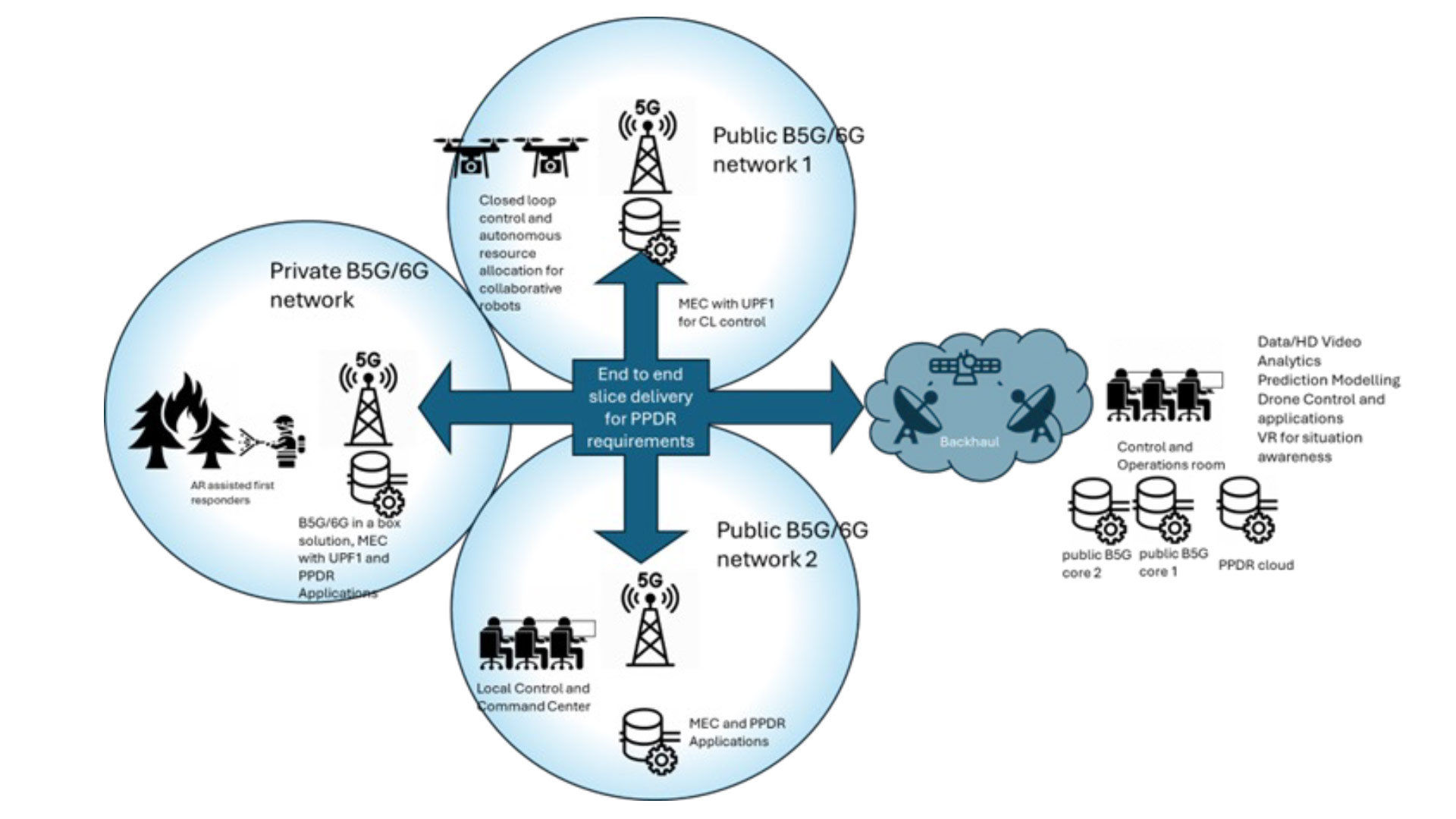
For emergency service teams, reliable and secure data processing and communication are crucial. With mission critical broadband services and infrastructure at their disposal, first responders can communicate with the Local Control Center (LCC) and Central Control Centers (CCC) more efficiently. Also, they can be accurately assisted by high performance models and predictions and enhance their situational awareness. It is essential that robust and reliable communication is maintained in the area affected by an incident, even if the digital infrastructure is destroyed or underperforming. Therefore, this Use Case aims to deliver ubiquitous B5G/6G connectivity to a Public Protection and Disaster Relief (PPDR) campaign through interworking and convergence of multiple networks.
Assuming a wide-area emergency (wildfire/earthquake), with disruptions on the digital infrastructure, this use case will be designed for a high priority and increased quality PPDR service deployment, with a network slice over a private B5G/6G network, that can be interconnected to a public B5G/6G network. The PPDR service will maximize coverage and network performance within the affected area. This Use Case will demonstrate an end-to-end PPDR network slice over a private and a public Radio Access Network (RAN), the orchestration of network resources on-demand, the provision of Multi-Access Edge Computing (MEC) capabilities, and the interconnection of B5G/6G Core networks through their Application Functions, for fast provisioning and seamless operation.
P2: Mission critical services interoperability with other systems

The use case focuses on achieving interoperability between Beyond 5G (B5G)/6G networks and non-3GPP technologies such as Wi-Fi and satellite systems. Its primary goal is to deliver seamless, reliable connectivity for mission-critical services, particularly for first responders operating across national networks. Testing is carried out in the B5GTN test facility, where multiple connectivity options are combined to maximize coverage and resilience.
Key innovations include automated roaming and intelligent network selection to maintain continuous service, multi-network utilization for redundancy and performance optimization, and real-time monitoring supported by AI-driven decision-making. Service prioritization ensures that critical applications maintain high quality of service even under challenging and harsh conditions. The use case aligns with broader project objectives by addressing technical challenges in cross-network interoperability at both network and application levels. Real-world scenarios, such as handover between 5G and satellite connectivity in remote areas for the UE in responder vehicle, illustrate the practical benefits of these solutions. Use case aims to enable robust, uninterrupted communication for emergency services, which is challenging in remote low coverage areas.
P3: Emergency private B5G/6G communication on-the-move (Finland)
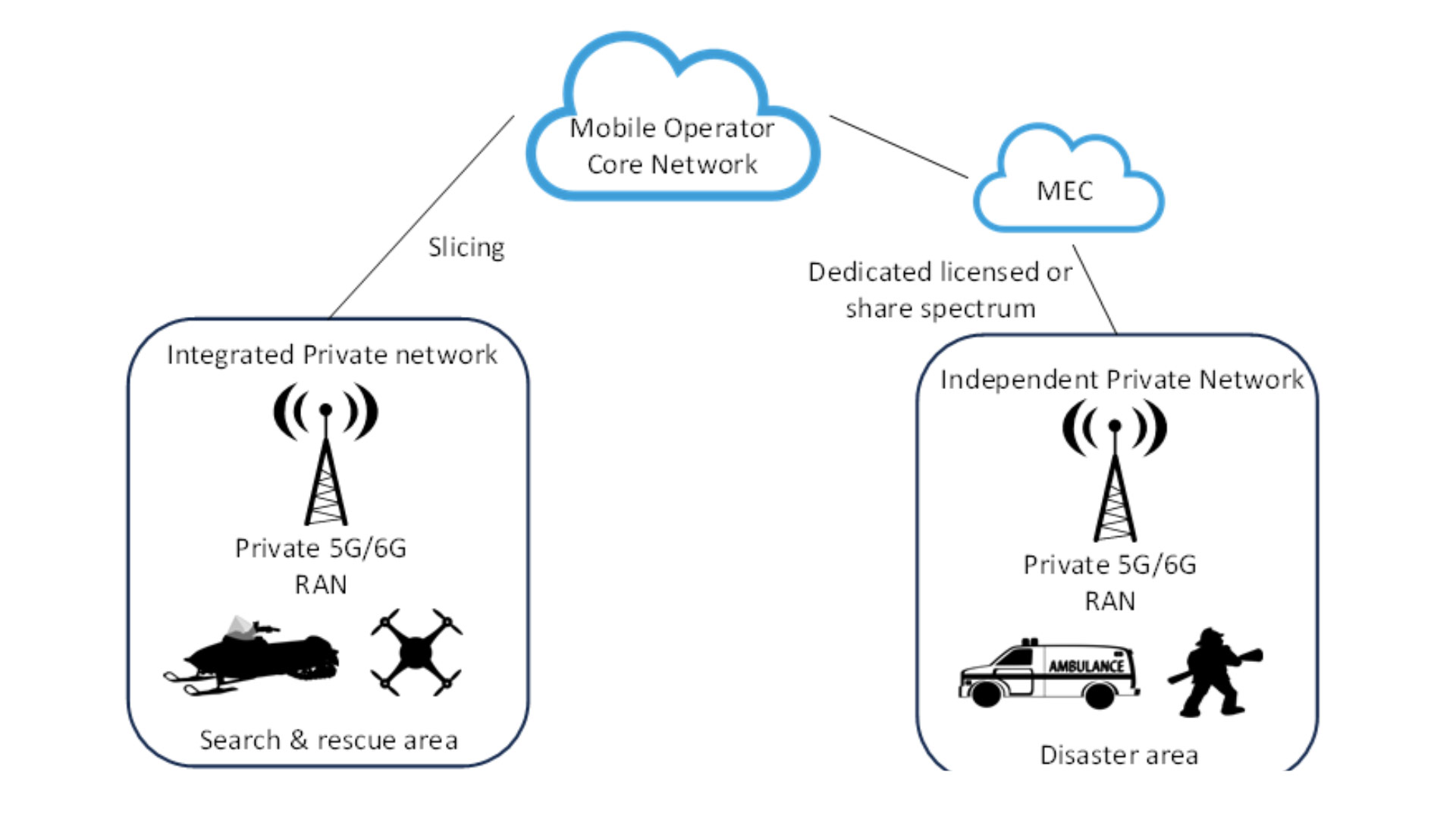
The use case focuses on enabling independent private B5G/6G networks for Public Protection and Disaster Relief (PPDR) operations in areas where public networks are unavailable. The approach involves deploying essential RAN and core network components at the network edge, ensuring secure and reliable connectivity without Internet access. Two main configurations are considered: independent private network and integrated private network. Both setups include edge services such as video streaming, object detection, and LiDAR processing.
Key communication enablers include network slicing and network exposure APIs, while innovations focus on tailored deployments, customized services for mission areas, and an analytics framework for the traffic monitoring. Challenges include integrating private networks with slicing, optimizing resource allocation between public and private networks, and managing architectural complexity. Field trials will validate these concepts through real-world scenarios, such as rescue operations in remote regions, where mobile private networks maintain high QoS and operational efficiency.
P4: Arctic Area Search and Rescue Operation
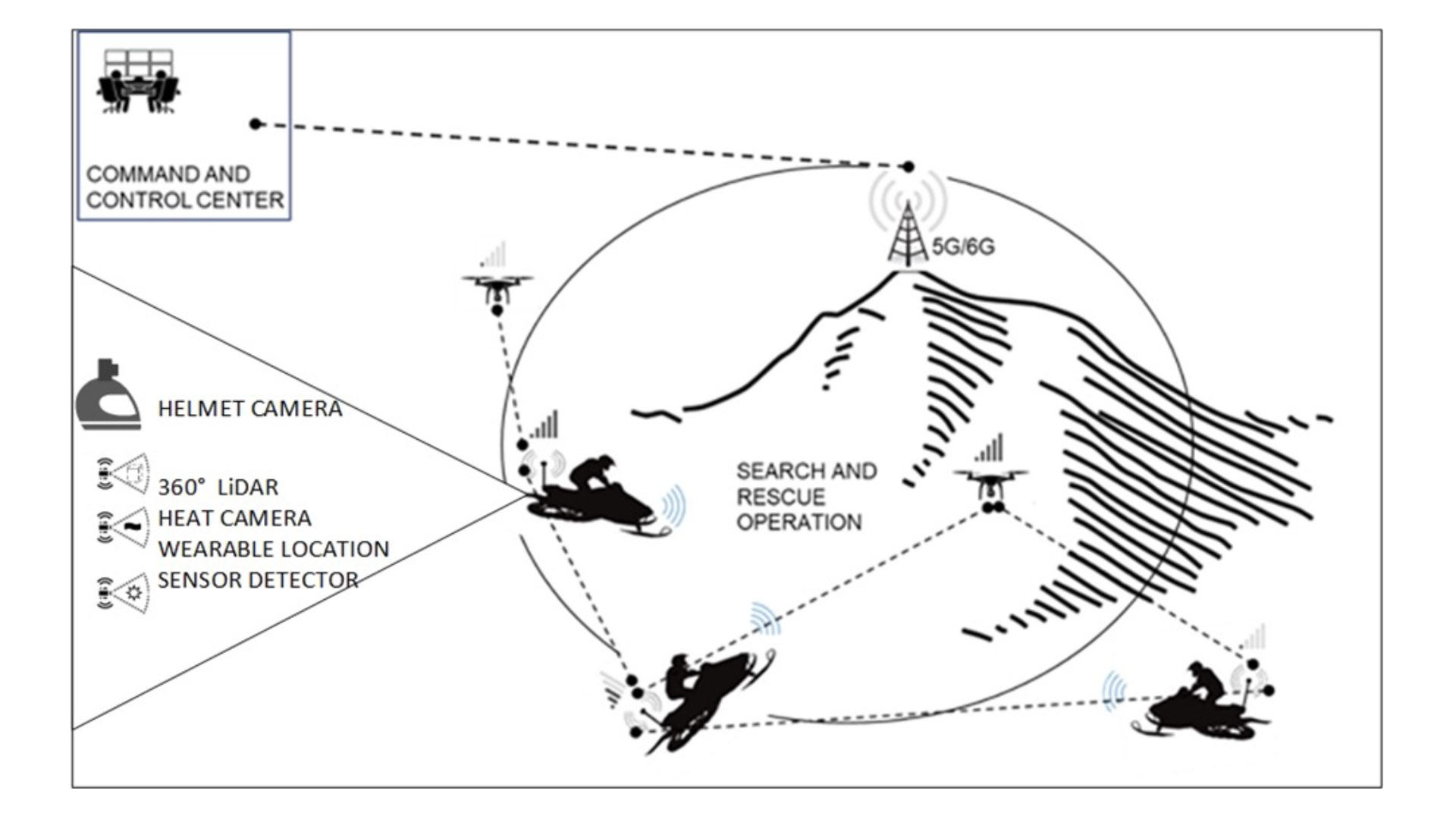
This use case provides effective ways of using B5G and alternative connectivity to communicate between first responder team in the snow avalanche site and Command-and-Control Center (CCC) coordinating remotely the rescue operation preparation to achieve fast situational awareness. The first responder search and rescue team is equipped with electric snowmobile eSled, packed with on-board instrumentation to detect the number and locations of avalanche victims and estimate the severity of the avalanche. Instrumentation consists of LiDAR 3D-monitoring device, GPS tracker, heat camera and spectrum analyzer, along with driver helmet camera and mobile phone voice link, everything shared with CCC in real-time, enabling avalanche site detection to be completely coordinated by CCC.
Multitude of sensor systems doing parallel continuous measurements in rural area, all data delivered to remote CCC location, sounds a bit of a challenge to the communication network! It is indeed an ultimate challenge. We need to be able to send huge amounts of continuous measurement data and adequate-quality video-feed for real-time remote monitoring purposes, relying on B5G networking capabilities in rural location and harsh weather conditions, with likely risks of poor connectivity. We must prepare for employing hybrid communication systems (WiFi, satellite), exploit eSled power systems for enhancing communication and prioritization of delivered data sources, to ensure operability in all circumstances.
P5: Emergency private 5G/6G communication on-the-move (Romania)

This use case demonstrates a portable communication system designed to provide mission-critical voice, video and data services for emergency teams in areas where commercial networks are unavailable or damaged. The tactical bubble includes a portable gNB, a local B5G standalone core network, MCX servers and an edge-compute platform that can run with satellite backhaul or operate in fully isolated mode. The system supports group calls, video streaming from bodycams and drones, file transfer, SOS alerts and location tracking. It is designed for fire brigades, medical teams, gendarmes and other responders who depend on reliable communication and near-real-time situational awareness. KPIs such as latency, service availability, call setup time and reliability have been defined to measure performance during trials. In the first year, the architecture, scenarios and trial plan were completed, including the two validation modes: satellite-connected and standalone. The ORO 5G Lab was prepared as the main integration site and the core network and MCX platform were installed. Equipment acquisition has started, including rugged terminals, bodycams, UAVs, IoT sensors, the portable gNB and the satellite terminal. Preparation meetings with STS and ORO aligned expectations for the first field tests, and operational requirements such as priority handling and emergency call flows were defined. Monitoring and automation tools in the ORO 5G Lab are ready to support controlled end-to-end testing of MCX services.
Use case
- Ubiquitous B5G/6G communication and slice deployment across operators for PPDR AR/VR assisted Control Centres
- Mission critical services interoperability with other systems
- Emergency private 5G/6G communication on-the-Move
- Arctic Area Search and Rescue Operation
- Emergency private 5G/6G communication on-the-move
Sustainability aspects (i) Environmental, (ii) Societal, (iii) Economic
(i) reduced loss of nature, carbon footprint and energy consumption;
(ii) reduced loss of lives and increased safety for victims and rescue workers;
(iii) reduced loss of man-made structures; reduced cost of rescue operations
Related sites
Greek
Finnish
Finnish
Finnish
Romanian